
Unlock the Editor’s Digest for free
Roula Khalaf, Editor of the FT, selects her favourite stories in this weekly newsletter.
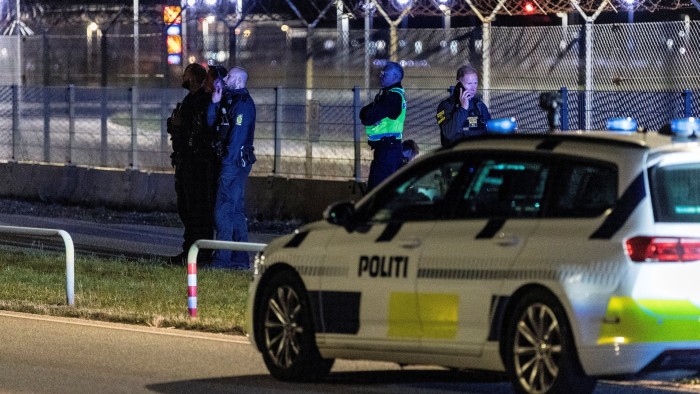
Denmark’s prime minister said the country had suffered the “most serious attack to date” on its critical infrastructure after its biggest airport was shut down by unknown drones in its airspace.
Mette Frederiksen said Denmark did “not rule out any options” over who piloted the drones that flew over Copenhagen airport on Monday, halting its operations for several hours. Nato and the EU on Tuesday blamed Russia’s “irresponsible” behaviour in similar recent incidents with drones and fighter jets breaching their airspace.
Oslo airport in Norway was also shut for a few hours on Tuesday after unidentified drones were spotted, Norwegian police said.
“What we saw last night is the most serious attack to date on critical Danish infrastructure. It says something about the times we live in and what we as a society have to be ready to handle,” Frederiksen said on Tuesday.
“It is clear that this fits in with the developments we have seen recently with other drone attacks, violations of airspace and cyber attacks on European airports.”
Flemming Drejer, head of the Danish intelligence and security service, refused to rule out Russian involvement and called the situation “extremely serious”. “We in Denmark face a high threat of sabotage,” he said, adding that an investigation was being carried out in co-operation with several other countries.
Danish police earlier said they had seen several large drones — most likely piloted by a “capable actor” — flying over the airport, the busiest in the Nordic region.
Authorities did not shoot down the drones because of their proximity to local houses and passenger aircraft filled with fuel, police added on Tuesday.
Ukrainian President Volodymyr Zelenskyy said on X that he had spoken about “Russia’s violations of the airspace of Nato member states, including on September 22 in Copenhagen”, during a meeting with the head of the IMF in New York.
Europe remains on high alert after several Russian incursions into Nato airspace in recent days, including multiple drones in Poland, a single one in Romania and three MiG-31 fighters flying over Estonian territory for 12 minutes on Friday.
Both Poland and Estonia invoked Article 4 of the Nato treaty to start formal discussions with allies, and calls are growing from frontline states for clearer rules of engagement to shoot down any Russian aircraft that enter the alliance’s airspace.
Nato said on Tuesday the Russian fighter jets that breached allied airspace in Estonia last week were “part of a wider pattern of increasingly irresponsible Russian behaviour”.
“Russia bears full responsibility for these actions, which are escalatory, risk miscalculation and endanger lives. They must stop,” the alliance said, adding that it had dispatched more fighter jets and air defences to bolster its eastern flank.
It warned Moscow that Nato would deploy “all necessary military and non-military tools to defend ourselves and deter all threats from all directions” and that its commitment to the mutual defence clause was “ironclad”.
European Commission president Ursula von der Leyen said she had spoken with the Danish premier about the drone incident and that “while the facts are still being established, it is clear we are witnessing a pattern of persistent contestation at our borders”.
“Our critical infrastructure is at risk. And Europe will respond to this threat with strength [and] determination,” she added.
Von der Leyen has called for the creation of a “drone wall” on the EU’s eastern flank to protect its airspace from Russian incursion. Defence ministers, including Denmark’s, will discuss the idea at a meeting on Friday.
EU foreign policy spokesperson Anitta Hipper said that “what we have seen throughout the last weeks points out to Russia, in terms of their reckless actions in at least three member states”.
“We see a clear pattern. Russia is testing the European borders [and is] also probing our resolve and undermining our security throughout.”
Kremlin spokesperson Dmitry Peskov said Russia took a “very responsible position” and that its aircraft did not violate international regulations. He also disputed the suggestion that Russian drones had entered Danish airspace.
“Any accusation against our military that our aircraft are allegedly violating any borders have never been supported by any reliable data or convincing arguments,” Peskov told reporters on Tuesday.
Frontline countries in the Nordics, Baltics and eastern Europe have been among the most enthusiastic supporters of Ukraine with military aid, and have also dramatically increased their own military spending.
But questions remain about the state of European air defence capabilities, especially with regard to drones. Many Nato countries have expensive fighter jets and surface-to-air missiles, but possess few of the cheaper systems that Ukraine has pioneered to combat Russian drones, which often cost about just $20,000 compared with $500,000 for a single western missile.
Additional reporting by Laura Dubois and Henry Foy in Brussels and Courtney Weaver in Berlin
Read the full article here